Read Our Latest Blogs
Explore our collection of informative blogs that serve as comprehensive guides for loan applications. Whether you're a first-time homebuyer or looking to refinance, our expertly crafted articles provide step-by-step instructions, essential tips, and valuable insights to navigate the loan application process smoothly. From understanding different loan types to optimizing your credit score, our blogs are your go-to resource for making informed financial decisions.
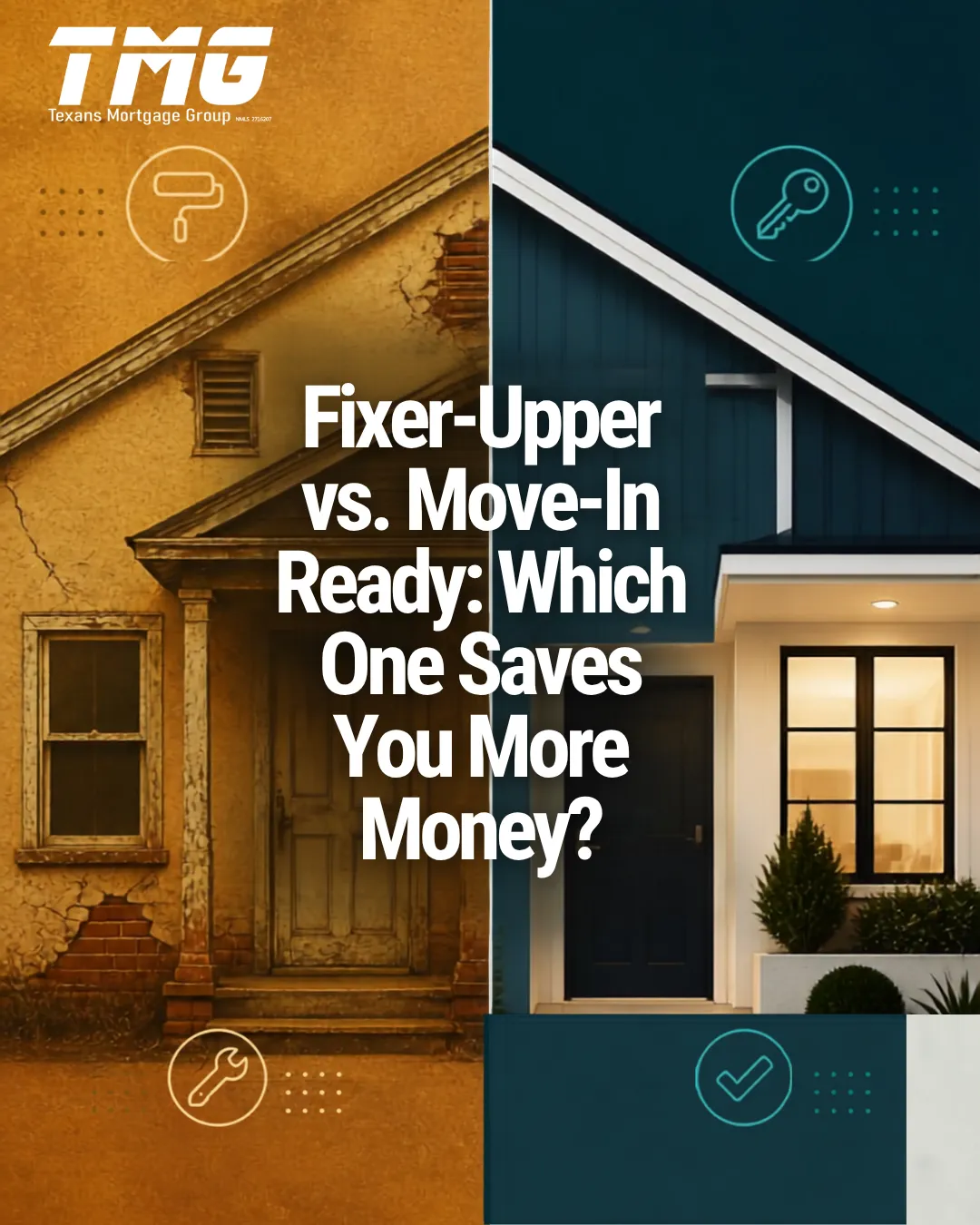
Fixer-Upper vs. Move-In Ready: Which One Saves You More Money?
“Beware of little expenses; a small leak will sink a great ship.”
- Benjamin Franklin
Buying a home is one of the biggest financial decisions you'll ever make. But when it comes to choosing between a fixer-upper and a move-in-ready property, the lowest asking price doesn't always mean the biggest savings.
Imagine finding two homes in your dream neighborhood. One is priced significantly lower but needs a new roof, updated plumbing, and a fresh coat of paint. The other costs more but is ready for you to move in as soon as you get the keys.
Which one is the smarter financial choice?
The answer depends on more than the purchase price. Your budget, renovation costs, financing options, and long-term plans all play a role in determining which home offers the best value.
Let's break down the differences.
1. The Appeal of a Fixer-Upper: Lower Price, More Potential
A fixer-upper is a property that needs repairs, renovations, or upgrades before it reaches its full potential. These homes often attract buyers because they may have lower asking prices than comparable move-in-ready properties.
Why a Fixer-Upper Could Save You Money
A lower purchase price. A fixer-upper may allow you to enter a desirable neighborhood at a lower price point, depending on the property's condition and local market.
The opportunity to build equity. If you purchase the property at a favorable price and complete cost-effective improvements, you may increase its market value. However, renovations do not guarantee a profit, and the results depend on market conditions and the quality of the work.
The freedom to customize. You can renovate the home to fit your preferences, from updating the kitchen to redesigning the bathroom. You may also choose which projects to complete first based on your budget.
The Hidden Costs to Watch Out For
The biggest mistake buyers make is underestimating renovation expenses.
A home that looks like it only needs cosmetic updates could have underlying problems, including:
Roof damage or leaks
Outdated electrical wiring
Plumbing issues
Foundation problems
Water damage or mold
Heating and cooling system repairs
These issues can quickly turn an affordable property into an expensive project.
Smart buyer tip: Before purchasing a fixer-upper, schedule a professional home inspection. Consider additional inspections for major systems or structural concerns when recommended. Knowing what needs attention can help you estimate the true cost of ownership before committing.
2. Move-In Ready: Pay More Upfront, Worry Less About Repairs
A move-in-ready home is generally in a condition that allows you to occupy it without needing major immediate renovations. It may still need minor maintenance or future updates, but significant repairs are less likely to be necessary right away.
Why a Move-In-Ready Home Could Save You Money
Fewer immediate expenses. You may avoid the need to spend thousands of dollars on urgent repairs or renovations immediately after closing.
More predictable budgeting. Without a long renovation list, you can focus on your mortgage, utilities, insurance, property taxes, and regular maintenance.
Less time and stress. You won't have to coordinate contractors, compare renovation quotes, or manage construction projects while trying to settle into your new home.
Potentially fewer surprises. A well-maintained home can make it easier to plan your finances, although even move-in-ready properties can have hidden defects.
What Should You Consider?
Move-in-ready homes often command higher asking prices, depending on the neighborhood, property condition, and current market demand.
You may also pay a premium for modern finishes, updated kitchens, new appliances, or other improvements that previous owners have already completed.
The key question is whether that higher price is justified by the home's condition, location, and overall value.
3. Let's Compare the Numbers
Sometimes, the easiest way to understand the difference is to look at a hypothetical example.
Suppose you're considering two homes in the same general area.
Expense | Fixer-Upper | Move-In Ready |
|---|---|---|
Purchase Price | $200,000 | $240,000 |
Estimated Renovation Costs | $25,000 | $0 in immediate major renovations |
Additional Repair Budget | $5,000 | $0 in immediate major renovations |
Estimated Total Before Closing Costs and Other Expenses | $230,000 | $240,000 |
Note: These figures are illustrative examples, not actual market prices or contractor estimates. The comparison excludes closing costs, financing expenses, taxes, insurance, ongoing maintenance, and other ownership costs. The move-in-ready home may still require repairs or maintenance.
In this example, the fixer-upper costs approximately $10,000 less before closing costs and other expenses.
That sounds like a clear win for the fixer-upper, right?
Not necessarily.
If the renovation costs increase by $15,000 because of unexpected problems, the fixer-upper's estimated total rises to $245,000. Suddenly, the move-in-ready home may be the less expensive option.
And there's another factor to consider: time.
If renovations take several months, you may need to pay for temporary housing, storage, or other additional expenses. Those costs can reduce or eliminate your expected savings.
The bottom line: Compare the total estimated cost of buying and preparing each home, not just the asking price.
4. Don't Forget the Cost of Financing
Your mortgage can also affect which option makes the most financial sense.
A lower-priced fixer-upper may require less money to purchase, but renovation expenses can create an additional financial burden.
Depending on the property and your loan program, you may need to explore financing options that account for both the purchase and eligible renovation costs. These programs have specific requirements, so speak with a qualified mortgage professional before assuming you can finance the repairs.
For a move-in-ready home, the higher purchase price may mean a larger mortgage and potentially higher monthly payments.
When comparing your options, consider:
Your down payment
Estimated monthly mortgage payments
Interest rate and loan terms
Closing costs
Available renovation financing
Cash reserves remaining after closing
Remember, using all your available savings to purchase a home can leave you financially vulnerable when unexpected expenses arise.
Choose an option that allows you to maintain a reasonable emergency fund after moving in.
5. Which Option Is Better for Your Financial Situation?
The right choice depends on your circumstances, priorities, and willingness to take on additional work.
A Fixer-Upper May Be Right for You If:
You have savings available for repairs and unexpected expenses.
You're comfortable managing renovation projects.
You have the time to oversee contractors or complete some improvements yourself.
You've researched local property values and understand the home's potential.
The purchase price and realistic renovation budget leave you with an attractive overall cost.
A Move-In-Ready Home May Be Right for You If:
You want to move in without major renovation delays.
You prefer predictable expenses.
You have limited time to manage contractors and repairs.
You don't want to take on the financial uncertainty of a major renovation.
You find a property whose price is reasonable relative to its condition and comparable homes.
Neither option is automatically better. The goal is to find a home that fits both your lifestyle and your financial situation.
6. Five Smart Tips Before Making Your Decision
Before choosing between a fixer-upper and a move-in-ready home, take these steps:
1. Get a professional home inspection. Understand the property's condition before committing to the purchase.
2. Request realistic renovation estimates. Speak with qualified contractors and compare written estimates instead of relying on guesses.
3. Set aside a contingency fund. Renovation costs can increase when contractors uncover unexpected problems. Your contingency should reflect the property's condition and the scope of the work.
4. Compare similar properties. Look at recently sold homes in the same area to understand whether the asking price reflects the property's condition and local market value.
5. Think beyond the purchase. Consider monthly payments, utilities, insurance, property taxes, maintenance, and how much cash you'll have left after closing.
Taking these steps can help you avoid costly surprises and make a more confident decision.
So, Which One Actually Saves You More Money?
The truth is that neither a fixer-upper nor a move-in-ready home guarantees greater savings.
A fixer-upper may offer a lower total cost if you purchase wisely, accurately estimate repairs, and manage renovations within budget.
A move-in-ready home may offer better value if the higher purchase price is offset by fewer immediate repairs, less renovation spending, and a more predictable move-in process.
The smartest purchase isn't necessarily the cheapest house. It's the one that delivers the best overall value without putting your financial stability at risk.
Before making an offer, compare the complete cost of each option, understand the risks, and make sure the home supports your long-term goals.
Because when it comes to buying a home, a little preparation today can help you avoid expensive surprises tomorrow.
Thinking About Buying a Home?
Whether you're considering a fixer-upper or a move-in-ready property, having the right information can make all the difference.
Take the time to evaluate your options, ask questions, and understand the numbers before making a decision.
Your future home should be an investment in your life, not a source of unnecessary financial stress.
Disclaimer: This content is intended for general information purposes and not as personalized financial advice. For tailored guidance, consult with the experts at Texans Mortgage Group.

Categories


Hear What Our Clients Say
Reviews were imported from Google & Facebook

Diana Garcia-Tellez
The process was fast and smooth. Rudy answered all my questions and helped me understand the process. The staff was always checking in with me to make sure I submitted the correct paperwork. I will definitely use their service again.

Diana H.
I was very pleased with every step of the process. Rudy was attentive and very thorough. The staff was super friendly and very patient with all of my questions and paperwork needs.

Diego V
Very professional group of people. They will help you understand every step of your mortgage process and answer any question you have along the way. Strongly recommend!

Nydia Garcia
Awesome customer service. They walked me through the process of buying my first home. Helped me understand the process and assist me with all my questions. I will recommend them 💯

Address: 910 Fairmont Pkwy. #145, Pasadena, TX 77504
COMPANY NMLS: 2716207
RUDY ZARATE | NMLS #262973 | Texans Mortgage Goals LLC | NMLS #2716207
This is not a commitment to lend. All loans are subject to credit approval.
All Rights Reserved.
tmg@rudyzarate.com
Our Houston, TX Office:
(281) 747-6699
Operating Hours:
Mon 08:30 am – 05:30 pm
Tue 08:30 am – 05:30 pm
Wed 08:30 am – 05:30 pm
Thu 08:30 am – 05:30 pm
Fri 08:00 am – 05:00 pm
Weekends Closed